
Written under our editorial standards.
Text and primary sources reviewed: 13 October 2026. This guide mainly covers Kindergeld under the Income Tax Act (EStG). Nationality, residence, tax status and the child’s circumstances can affect the route. Another scheme under BKGG covers specific groups; living in Germany or holding any work permit alone does not settle entitlement.
2026 amount: €259 for each eligible child
Section 66 sets €259 per month for an eligible child. Three qualifying children in one month give 3 × €259 = €777. Payment runs from the start of the month in which the conditions are met to the end of the month they cease. Foreign benefits and coordination may alter the actual payment. Kindergeld, Kinderzuschlag, Elterngeld and maintenance advances have different rules.
Check your route before reading the permit label
Section 62(1) starts with German domicile or habitual residence, or the specified tax routes under sections 1(2) and 1(3) for people abroad. Section 62(2) concerns foreign nationals without free-movement entitlement; it does not mean everyone who is not German.
| Situation | What needs checking |
|---|---|
| Settlement or EU long-term residence | Section 62(2)(1), plus the other parent and child conditions |
| Blue Card, ICT, Mobile ICT or employment permit | Section 62(2)(2), work authorisation and its duration, with purpose-specific exceptions |
| Study §16b, recognition §16d, search §20 or follow-up card §20a(5), sentence 2 | Actual employment, qualifying parental leave or ongoing cash benefits under SGB III, alongside the other requirements |
| §16e, au pair/seasonal work §19c(1), §19e, search card §20a(5), sentence 1 | Excluded from the number 2 route by letter a; a side job does not automatically remove that exclusion |
| War-related §23(1), §23a or §25(3–5) | Number 3 activity/parental-leave/SGB III route, or number 4’s qualifying 15-month residence route |
| Beschäftigungsduldung | Number 5 refers to the specific §60d status with §60a(2), sentence 3; ordinary Duldung is different |
The six-month wording concerns authorisation to work for the stated period, including qualifying previous authorisation. It is not a universal six-month waiting period or six months of actual employment; the permit’s expiry date alone is insufficient. SGB III cash benefits are not every social payment: Bürgergeld under SGB II is a different scheme.
Refugees and temporary protection: avoid a blanket 15-month wait
The 15-month route requires one of the current permits listed in letter c, plus the qualifying permitted, authorised-asylum or tolerated residence. Fifteen months of ordinary Duldung or Gestattung alone do not satisfy that route. Sections 25(1–2) are distinct from the listed 25(3–5), and temporary protection under §24 is not in letter c. Do not impose that wait on all recognised refugees; check the correct status and other conditions.
Example: a non-working holder of §25(3) may need the qualifying 15-month route. A student under §16b who lawfully works should not be rejected simply for the “study” label; the number 2 requirements still need checking. Neither example promises an award.
EU and cross-border families
EU/EEA and Swiss cases involve free-movement, coordination or agreement rules. The Court’s official account of C-411/20 explains that a lawfully resident EU citizen who actually establishes habitual residence cannot be excluded during the first three months solely for having no local employment income. A temporary visit is insufficient. Read §62(1a) alongside that judgment and the facts, rather than treating its exclusion sentence as an unconditional rule.
Section 63’s ordinary child-residence rule covers Germany, EU or EEA with its stated exception. Swiss and treaty cases require additional rules. Official guidance identifies countries including Algeria, Morocco, Tunisia and Turkey for relevant agreement routes. Do not automatically reject every child outside Europe or promise €259; another country’s benefits, priority and difference payments need assessment, often with Anlage Ausland.
Child’s age, identification and recipient
For under-18s, check the general conditions. Sections 32 and 63 cover selected adult-child cases: registered job search before 21 without a disqualifying employment relationship; education, qualifying transitions of up to four months, training-place search or listed voluntary services before 25. For the number 2 cases in §32(4), such as education and qualifying transitions before 25, employment restrictions apply after first vocational education or a first degree, with statutory exceptions for regular work up to 20 hours weekly, training employment and qualifying minijobs. Disability arising before 25 and preventing self-support can permit a route beyond that age; disability alone is insufficient.
Parent and child identification are required. Section 63 allows suitable alternative identification for a child not subject to a tax law. A later number or identification can apply retrospectively when the other conditions existed; it is not a promise of payment before completion. Section 64 pays one recipient per child, using household, agreed-recipient or maintenance rules, rather than “always the mother”.
Valid application and retrospective payment
Apply through Familienkasse’s official channel under §67. Its service offers electronic submission; with Bund-ID the stated route does not need printing and a handwritten signature. For paper or cross-border forms follow the actual signature and submission instructions. Keep evidence of receipt; a phone enquiry alone is not automatically a valid application.
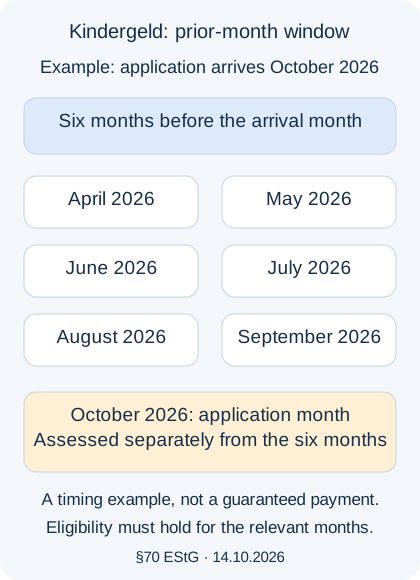
Section 70 limits retrospective payment to six months before the month the application arrives, without removing the underlying entitlement. Example: a valid application received in October 2026 and one continuously qualifying child has an April–September prior-month window. At €259, that illustration totals €1,554; October is assessed separately as the application month. Later eligibility or foreign benefits change the result.
Supply requested evidence and report relevant changes directly to Familienkasse under §68, including residence, care, education and relevant foreign benefits. Informing Jobcenter alone is insufficient. If refused, read the decision’s appeal instructions promptly; this guide does not calculate your individual deadline.
Prepare a usable file
- Parent and child identifiers, contact and bank details in the official application.
- Birth/relationship, household and residence evidence, permit or recognition decision.
- Employment, qualifying parental leave or SGB III evidence where needed; adult-child education/search evidence.
- Cross-border residence, employment and benefit details and the requested international forms.
Read this guide in Arabic · Read in German. Keep tax IDs and children’s documents out of public comments.
Sources and limits
§ 62 EStG · § 63 EStG · § 64 EStG · § 66 EStG · § 67 EStG · § 68 EStG · § 70 EStG · § 32 EStG · Familienkasse: Antrag / application · Kindergeld ab 18 · Grenzüberschreitende Fälle / cross-border cases · Merkblatt 2026 · EuGH C-411/20: amtliche Presseinformation · § 1 BKGG
Selected claims checked; not every tax situation, treaty or individual family assessed. The official court press information explains the judgment; no claim of reviewing the complete case file. BKGG, including some orphan self-claims, requires its own conditions.
Frequently asked questions
Are students always excluded?
No. For §16b, actual employment, qualifying parental leave or SGB III cash benefits are relevant alongside the other route conditions. Au pair, §16e and search-card exclusions are different and are not automatically removed by a side job.
Must every recognised refugee wait 15 months?
No. That route concerns the specifically listed permits, including §25(3–5), with the other conditions. Do not generalise it to §25(1–2), §24 or ordinary Duldung alone.
What is the 2026 amount?
€259 monthly per eligible child in the basic §66 route. Three eligible children give €777 for a month; coordination and individual conditions can alter actual payment.
Should I postpone applying until the tax ID arrives?
Avoid unnecessary delay: use the correct official procedure and keep receipt evidence. Identification is required, but later assignment can act retrospectively when the conditions existed; follow instructions for missing evidence.
Is a child abroad always excluded?
No. Residence, EU/EEA, Swiss, agreement and exception rules matter. Have the cross-border amount and paying-country priority assessed; neither automatic exclusion nor full payment is safe to assume.
Which prior months are covered by an October 2026 application?
The §70 illustration covers April–September 2026 if the conditions persisted. October is the application month, assessed separately from the previous six.
Application and checking steps
- Identify the route Record residence provision, free-movement status, activity and residence dates, and the child’s age and location.
- Prepare the evidence Gather identification, birth, care, residence and required activity or education documents; add international evidence where relevant.
- Submit through the official channel Follow Familienkasse’s submission/signature requirements, keep receipt proof and supply requested missing documents.
- Read the decision and report changes Check months, amount, reasoning and appeal instructions; send relevant changes directly to Familienkasse.