Written under our editorial standards.
Targeted source review: 12 October 2026. The specified provisions and linked-tool limits were checked; this is not a complete legal audit or an individual entitlement decision.
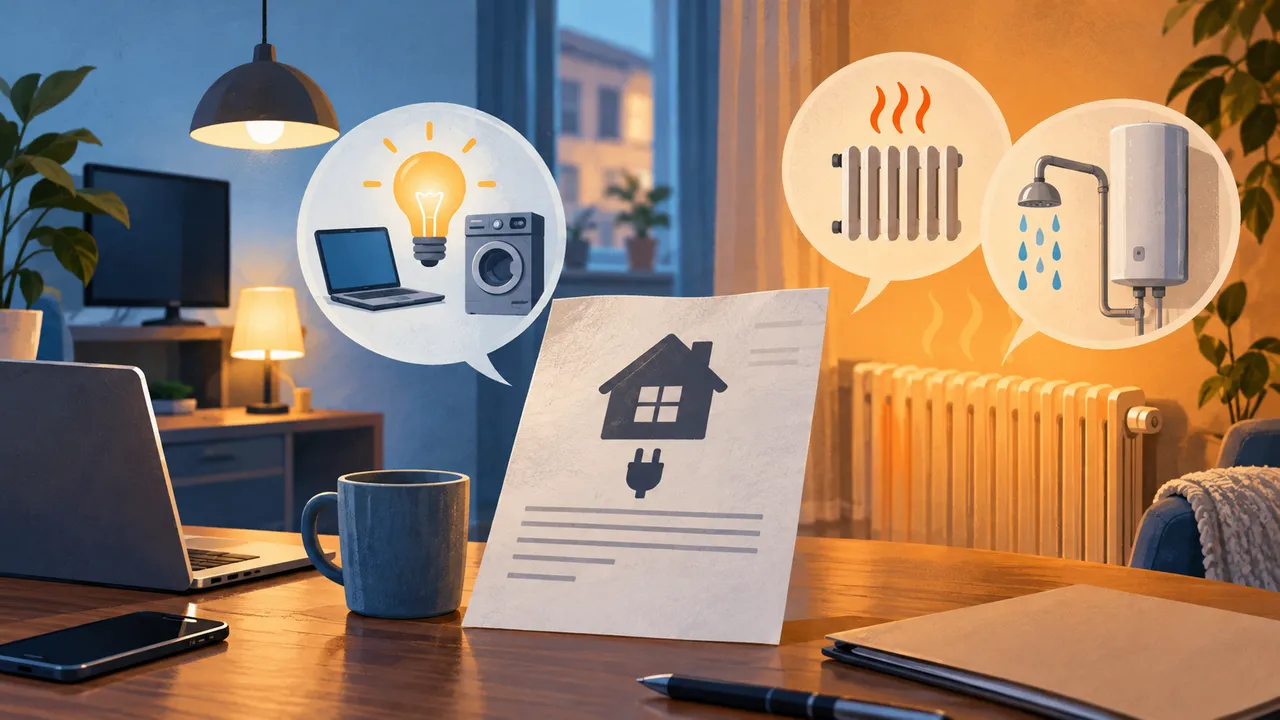
Electricity for household appliances and lighting ordinarily comes from standard need. Heating and central hot water fall under section 22 subject to appropriateness. One electricity bill can include heating or hot-water equipment; separate uses before classifying the whole amount.
Where each bill belongs
- Household electricity
- Inside the lump sum — Section 20 counts "household energy" as part of the standard requirement.
- Heating
- Heating is outside the lump sum and assessed under section 22 subject to appropriateness, including electric heating; separate and evidence its share.
- Centrally supplied hot water
- Outside too — excluded by the same clause and counted with heating.
- Decentralised hot water
- A heater inside the dwelling ⇒ not Section 22 but an additional requirement at a percentage rate under Section 21(7).
- The percentages
- For each entitled person under section 21(7):2.3%for designated adult levels,1.4%at 14–17 in the designated level,1.2%at 6–13 and 0.8%at 0–5. Decentralised production and no already-recognised central-water need are required; check the decision’s level.
- Above the percentage
- Counted only if evidenced by a separate measuring device.
A heater in your flat changes the whole calculation
Central hot water is assessed under section 22 subject to appropriateness. Decentralised hot water falls under section 21(7)where central provision is not already recognised; a device in the flat alone does not justify double counting.
For each entitled person under section 21(7):2.3%for designated adult levels,1.4%at 14–17 in the designated level,1.2%at 6–13 and 0.8%at 0–5. Decentralised production and no already-recognised central-water need are required; check the decision’s level.
State and evidence the hot-water system and check the decision. The subsistence application generally covers additional needs; a separate application is not always required.
And if your actual consumption exceeds the percentage, the statute opens exactly one door: a separate measuring device evidencing the difference. Without one, the excess is not recognised however large the bill.
An electricity refund stays yours — by express provision
This point returns money to recipients who assume it is lost. The general rule in Section 22(3) is that refunds and credits attributable to accommodation and heating reduce the following month's costs — so a heating refund is effectively deducted.
Household-energy refunds are excluded under section 22(3). For mixed bills separate electric-heating and central-water shares; the supplier name alone does not decide.
The same is said of refunds relating to accommodation and heating costs that were not recognised: those too are not counted against you.
When the supplier threatens disconnection
The statute does not leave this case unaddressed, but its response sits in two places:
Direct payment. Section 22 provides that the accommodation payment should go straight to the landlord or other person entitled to receive it where proper use is not assured — and it names among the examples energy arrears that would justify an interruption of supply.
Taking over debts. The same provision allows debts to be taken over where justified to secure the accommodation or to relieve a comparable emergency — and a disconnection falls under that heading. Available assets are used first, and the money is normally provided as a loan.
There is a third, broader door with conditions attached: Section 21(6) recognises an additional requirement where the individual case presents an unavoidable special need, provided it is large enough to deviate appreciably from an average need and cannot be met from third-party support or by economising. For one-off needs it is further required that a loan be exceptionally unreasonable or impossible.
What to do now
- Check the system and decision Evidence decentralised production and check that central hot-water costs are not already recognised.
- Claim the rate in writing for each person separatelyIt is calculated for every entitled person in the household by age band, not once for the family.
- Check evidence before buying a meter Higher section 21(7)costs require separate measurement. Ask what evidence is acceptable before paying for installation; a large bill alone does not establish entitlement.
- Identify the refund components Separate ordinary household electricity from heating/hot-water refunds. An excluded component is not a reason to ignore reporting a material change.
- Check that heating and central hot water are not charged to you twiceThey are outside the lump sum by the wording of Section 20 and paid at actual cost under Section 22.
- Facing disconnection, ask for direct payment and debt takeover togetherNot one or the other. The first prevents a repeat, the second deals with what has accumulated — and both are provided for.
Separate appliance/lighting electricity from electric heating and water. The statutory conditions, evidence and individual decision govern the route; this page has no evidence that a wrong route is the commonest refusal reason.
Official sources
Section 20 SGB II — household energy inside the standard requirement · Section 21(7) — decentralised hot water · Section 22 — heating and refunds
Please note: this page is general guidance, not legal advice. Every decision follows an individual assessment of your case, and the amounts are set by regulations that change annually — read your own decision letter and consult a social advice centre or a lawyer specialising in social law before acting.
Frequently asked questions
Does the Jobcenter pay the electricity bill?
Ordinary appliance and lighting electricity is normally included in standard need rather than paid separately. Electric heating and hot water have their own conditions and evidence rules; separate mixed bills.
And heating?
Outside the lump sum. Section 20 expressly excludes the shares attributable to heating and hot-water generation, and they are paid at actual cost under Section 22 so long as appropriate.
I have a heater in the flat — is there anything extra?
For each entitled person under section 21(7):2.3%for designated adult levels,1.4%at 14–17 in the designated level,1.2%at 6–13 and 0.8%at 0–5. Decentralised production and no already-recognised central-water need are required; check the decision’s level.
My bill is higher than the set percentage — what can I do?
The statute provides that higher expenses are taken into account only where evidenced by a separate measuring device.
I received a refund from the electricity company — is it deducted?
Ordinary household-electricity refunds do not reduce section 22(3)needs. Separate heating and central-water parts in a mixed bill, which may be treated differently.
I am facing disconnection over arrears — what is the remedy?
Two routes are provided: direct payment to the person entitled to receive it, which should happen where energy arrears would justify an interruption of supply; and taking over the debts where justified to secure the accommodation or relieve a comparable emergency, normally as a loan.
Can exceptional energy costs be recognised?
Section 21(6) recognises an additional requirement where an unavoidable special need exists, provided it deviates appreciably from an average need and cannot be met from third-party support or by economising.
Sources for this review and how to use them
Compare the facts and inputs with the official decision. Retain evidence and separate an estimate from entitlement; source pages may change.