Selected corrections on 12 October 2026 to family-reunification submission routes, language and the stated exceptions; no new verification of every appointment, fee or contact detail.
Written under our editorial standards.
Targeted source correction: 12 October 2026. This covers visa routes, the language requirement and the suspension; it is not a complete legal review or a new check of all addresses, hours and operational details below.
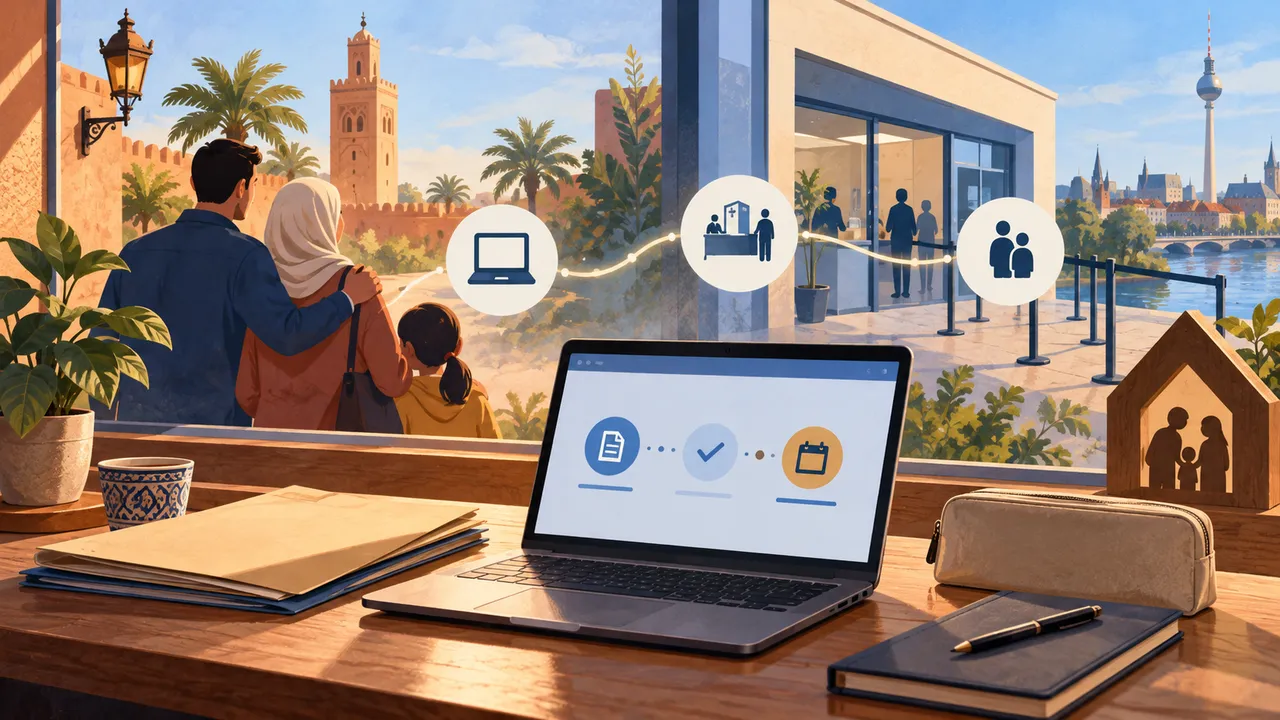
The Rabat instructions read on 12 October 2026 place ordinary family-reunification registration, apart from the suspended subsidiary-protection route, in the online portal from 1 March 2026. Documents are checked online for completeness, followed by embassy attendance for biometrics and fees. The embassy says existing waiting-list registrations are dealt with before portal appointments begin.
Where and how
- Reunification
- Ordinary family registration through the online portal since 1 March 2026, followed by embassy attendance for biometrics and fees. Some accompanying families use TLScontact in Rabat under specified categories.
- Schengen (for comparison)
- At TLScontact in Rabat, Marrakesh or Tangier.
- Embassy address
- 7 Rue Madnine, Rabat — the legal and consular section is at Avenue Sanhaja, Souissi.
- General hours
- Monday to Friday 09:00 – 12:00.
- Consular windows
- Legalisations 08:00 – 10:00; other services every day except Tuesday 09:00 – 10:30.
- Walk-in
- Not possible — consular services are restricted to pre-booked appointments.
Choose the family visa route by category
TLScontact also handles specified national categories, including researchers and certain accelerated skilled-worker cases with prior approval under section 81a. A family applying concurrently with one of those categories should book the principal applicant first, then telephone TLS for a family appointment. Do not assume either that all family visas use TLS or that TLS is excluded from every family application.
Online document checks do not remove the required attendance in Rabat for the ordinary portal route. Your category and appointment confirmation determine whether attendance is at the embassy or TLS; the Schengen centres in Marrakesh and Tangier cannot automatically be treated as national-visa application centres.
The language condition: what the text says and what the mission applies
The simple German required by section 30 has a statutory definition: section 2(9) of the Residence Act sets level A1. It is not merely an administrative practice. Check the mission’s checklist for your category for the accepted proof and certificates, taking the statutory exemptions into account.
Section 30(1) provides conditional exemptions, including inability to prove German because of illness or disability, certain low-integration-need cases, qualifying researcher or skilled-worker permits, and individual circumstances making pre-entry language-learning efforts impossible or unreasonable. The nationality exception in sentence 3 number 4 concerns the foreign resident in Germany who may enter and stay visa-free even for a non-short stay because of that nationality; it is not the arriving spouse’s nationality alone. Explain the relevant exception and evidence. These examples are not an exhaustive list or a guarantee.
The steps from Morocco
- Confirm your relative’s status firstCheck the current residence permit and, for protection cases, the BAMF decision. The route depends on that status; the section 36a suspension concerns subsidiary protection and does not automatically approve refugee, work or study routes.
- Choose the portal or TLS for your categoryUse the online portal for ordinary family registration. For a family applying concurrently with a specified national category handled by TLS, book the principal applicant first and telephone TLS for the family appointment. Check the attendance confirmation.
- Check the closure list before bookingThe embassy publishes an annual list combining German and Moroccan holidays, and some Hijri dates are listed as approximate. A closure on your day means booking again from scratch.
- Check language and translation documents earlyPrepare language proof if your category requires it and no exemption applies. Check the translation rules and accepted translators before paying; families do not all need the same certificate.
- If you need a legalisation, count the narrow windowLegalisations run from eight until ten in the morning only, and some services are not offered on Tuesday. Arriving outside the window means being refused entry.
- Attend with a complete file the first timeSince remonstration was abolished in July 2025, correcting a refusal runs through the Berlin Administrative Court or a fresh application — both far longer than preparing a missing paper.
⚠️ Section 104(14) suspends ordinary family reunification under section 36a to beneficiaries of subsidiary protection through the end of 23 July 2027. Sections 22 and 23 remain unaffected. The Foreign Office notice explains reporting hardship to [email protected] with reasons and individual assessment. The email is not a guarantee of admission and does not replace the other statutory exceptions. This particular suspension does not extend to refugee, work, study or Blue Card status merely on that basis; each route still has its own requirements.
Official sources
German Embassy Rabat — address and consular windows · Section 30 AufenthG · Notice on the suspension for subsidiary protection · Rabat registration and appointment instructions · Statutory language definition, section 2 · Scope of suspension, section 104(14)
Please note: this page is general guidance, not legal advice. Reunification cases are assessed individually — consult a lawyer specialising in immigration law or a migration advice centre before any decision concerning your family.
Frequently asked questions
Where do Moroccans file a reunification application?
Ordinary registration uses the online portal from 1 March 2026, followed by embassy attendance for biometrics and fees. Families applying concurrently with specified national categories may use TLS in Rabat. Follow the embassy’s category-specific instructions.
Can I file a reunification application in Marrakesh or Tangier?
Do not assume that a Schengen centre in Marrakesh or Tangier receives national family applications. The reviewed instructions specify embassy attendance for the ordinary portal route, and TLS in Rabat for specified categories and accompanying families. Follow your appointment confirmation.
What language level is required?
The simple German required by section 30 legally means level A1 under section 2(9), subject to statutory exemptions. Check your category’s checklist for accepted evidence and certificates.
Can the language condition be waived?
Yes, subject to section 30(1), including certain illness or disability, skilled-worker permits and individual circumstances. The nationality exception concerns the foreign resident in Germany and eligibility for visa-free longer residence, not the arriving spouse’s nationality alone. Set out the applicable facts and evidence.
Can I come without an appointment?
No. The embassy restricts consular services to booked appointments, and most windows do not exceed two hours.
Does the suspension apply to me?
Family reunification under section 36a to subsidiary-protection beneficiaries is suspended through the end of 23 July 2027; sections 22 and 23 remain unaffected. Other routes are outside this particular suspension but retain their own requirements.